What It Takes to Turn Wastewater Biogas Into RNG

.svg)
Wastewater treatment plants are among the steadiest anchor feedstocks for a biomethane project. Their digesters run continuously and put out a consistent gas flow, which is what a renewable natural gas (RNG) plant needs to size equipment and hold output. The chemistry is another matter. Of the common feedstocks feeding RNG, from agricultural residue to food waste to landfill, sewage digester gas carries the widest contaminant load. That load is what the gas train has to be built around, and it is the part most projects under-size.
A plant can meet its grid or vehicle-fuel specification on a good day and still run below rated output the rest of the time. The reason usually sits upstream, in a conditioning train sized against a generic inlet assumption rather than the gas the digester actually produces.
What sewage digester gas actually contains
Start with hydrogen sulphide. Municipal sludge is sulphur-rich, so H₂S in sewage digester gas commonly runs from several hundred ppm to a few thousand, and reaches 1 to 2 percent by volume where the feed carries a heavy sulphur load. At those levels it corrodes carbon steel, copper alloys, and downstream instrumentation, and it poisons the catalysts and media used later in the train.
Ammonia rides along with it. Sewage sludge is high in nitrogen from proteins and urea, and ammonia partitions into the gas as the digester runs. It attacks copper and brass, raises NOₓ when the gas is burned, and has to be stripped before upgrading. Every serious upgrading scheme lists ammonia among the components it must separate out, alongside CO₂, H₂S, water, oxygen, VOCs, and siloxanes.
Siloxanes are the contaminant that makes sewage distinct. Alongside landfill gas, sewage and municipal biowaste are the feedstocks that carry siloxanes at scale, which is why they enter the sewer from shampoos, detergents, and cosmetics, volatilise in the digester, and travel with the gas. D4 and D5 dominate, together accounting for more than 90 percent of the total siloxane content. Measured concentrations in wastewater digester gas typically fall in the range of 20 to 60 mg/m³, and sewage plants hold that load fairly steadily, unlike landfills where it drifts with age. The damage happens in combustion. Siloxanes convert to silicon dioxide, a glassy microcrystalline silica that deposits on engine surfaces and drives wear. Engine makers cap siloxane intake at roughly 5 to 28 mg/m³ for reciprocating units, and as low as 0.03 to 0.1 mg/m³ for turbines. Raw sewage gas sits well above both.
Then the VOCs. Sewage digester gas carries toluene, benzene, xylenes, halogenated compounds, mercaptans, and traces such as HCl. These foul membranes and adsorbent beds, add odour, and feed the acidic condensate that attacks piping.
Meeting spec, wherever the gas goes
Upgraded biogas has to meet the specification of wherever it is injected or dispensed, and those specifications differ by market. Europe's EN 16723 covers grid injection and vehicle fuel, and it puts explicit numbers on the contaminants sewage gas is worst for, holding total silicon to roughly 1 mg Si/m³ and ammonia to around 10 mg/m³. India's IS 16087:2025 requires methane at 95 mole percent minimum, total sulphur including H₂S at 10 mg/m³, H₂S alone at 3.7 mg/m³, moisture at 5 mg/m³, oxygen at 0.5 mole percent, and carbon dioxide at 4 mole percent, without putting a number on siloxanes or ammonia. In North America, pipeline injection is governed by individual pipeline gas-quality tariffs rather than a single national standard, with vehicle RNG tracked through programs such as the Low Carbon Fuel Standard and the Renewable Fuel Standard.
The specifications differ, the physics does not. The same contaminants have to come out of sewage gas regardless of where it ends up. Where a standard names a siloxane or ammonia limit, the plant designs to it. Where it stays silent, the engine, the membrane, and the fuel-cell stack still impose one, and it is tighter than any certificate. Meeting the spec is necessary without being the whole design brief. The conditioning still has to clear the full load the digester puts out.
How a wastewater-gas conditioning train is built
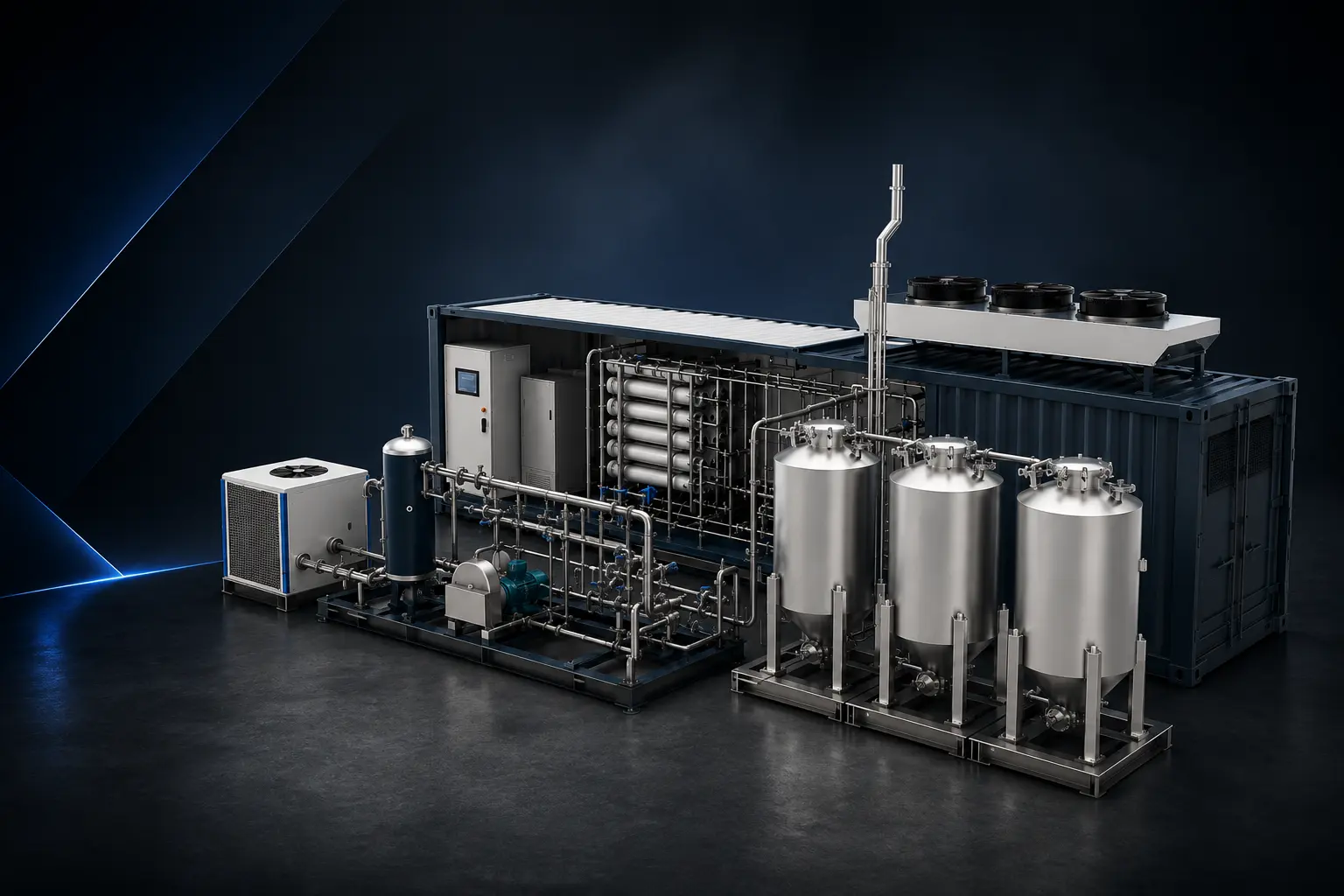
A sewage-gas train works in stages. Bulk H₂S removal comes first, sized to absorb wide swings, through a chemical or bio-regenerative scrubber that keeps air out of the gas. Moisture is dropped by chilling. Siloxanes and residual sulphur are polished on activated carbon. Carbon dioxide is then separated by membrane or water wash to lift methane to biomethane grade, above 95 percent. Sequence and sizing decide whether the polishing media lasts months or weeks, and getting that order wrong is a common way RNG projects erode their economics before they reach rated output.
Where CRA fits
Keeping biomethane on spec starts at the desulphurisation step. CRA sizes chemical, bio-regenerative, or dry-bed scrubbing to the feedstock's actual H₂S profile rather than a generic inlet assumption. The outlet H₂S figure that scrubber holds is the number the membrane upgrading system downstream is rated against, so when one partner designs both steps, that outlet spec is set to protect the membrane's rated service life rather than a figure written into a separate vendor's data sheet. A final activated-carbon stage removes siloxanes and trims residual H₂S to protect engines, turbines, and catalytic units.
That coordination is not new territory here. The same in-house engineering group that has designed flares and thermal oxidisers for three decades engineers the full gas train, from desulphurisation to methane slip destruction, on one design basis. For sewage gas, where no single stage clears the whole contaminant load, that single point of accountability is what keeps a plant on spec once it is running.
If you are scoping an RNG or biomethane plant on wastewater feedstock, send us your feedstock profile and target specification, and we will walk you through what the gas train needs to look like to hit it at rated capacity.
References
5. “Hydrogen sulphide management in anaerobic digestion,” Bioresource Technology.
6. “Removal of hydrogen sulfide in biogas from WWTP sludge,” IWA Water Practice & Technology.
7. “Influence of sampling on volatile methyl siloxanes in biogas,” Biomass and Bioenergy.
8. “Removal of siloxane from digestion gas of sewage sludge,” Bioresource Technology.
9. “Purification of wastewater digester biogas from siloxanes,” Renewable Energy.
10. “Biogasification of biowaste and sewage sludge, measurement of biogas quality.”